

Health Library
Nasal polyps
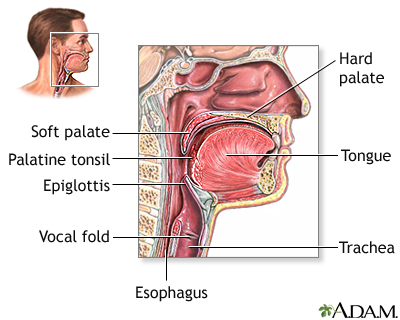
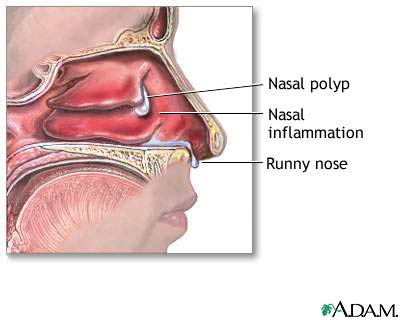
Nasal polyps are soft, sac-like growths on the lining of the nose or sinuses.
Images
I Would Like to Learn About:
Causes
Nasal polyps can grow anywhere on the lining of the nose or the sinuses. They often grow where the sinuses open into the nasal cavity. Small polyps may not cause any problems. Large polyps can block your sinuses or nasal airway.
Nasal polyps are not cancer. They seem to grow due to long-term swelling and inflammation in the nose from allergies, asthma, or infection.
No one knows exactly why some people get nasal polyps. If you have any of the following conditions, you may be more likely to get nasal polyps:
- Aspirin sensitivity
- Asthma
- Long-term (chronic) sinus infections
- Cystic fibrosis
- Hay fever
Symptoms
If you have small polyps, you may not have any symptoms. If polyps block nasal passages, a sinus infection can develop.
Symptoms include:
- Runny nose
- Stuffed up nose
- Sneezing
- Feeling like your nose is blocked
- Loss of smell
- Loss of taste
- Headache and pain if you also have a sinus infection
- Snoring
With polyps, you may feel like you always have a head cold.
Exams and Tests
Your health care provider will examine the inside of your nose and mouth. You may need to see an ear, nose, and throat (ENT, otolaryngologist) specialist who can look in your nose with special tools. They may also need to perform nasal endoscopy to see the full extent of the polyps. Polyps look like a grayish grape-shaped growth in the nasal cavity.
You may have a CT scan of your sinuses. Polyps will appear as cloudy spots. Older polyps may have broken down some of the bone inside your sinuses.
Treatment
Medicines may help relieve symptoms, but rarely get rid of nasal polyps.
- Nasal steroid sprays can sometimes shrink polyps. They help clear blocked nasal passages and runny nose. Symptoms return if treatment is stopped.
- Corticosteroid pills or liquid may also shrink polyps, and can reduce swelling and nasal congestion. The effect lasts a few months in most cases.
- Allergy medicines can help prevent polyps from growing back.
- Antibiotics can treat a sinus infection caused by bacteria. They can't treat polyps or sinus infections caused by a virus.
If medicines don't work, or you have very large polyps, you may need surgery to remove them.
- Endoscopic sinus surgery is often used to treat polyps. With this procedure, your surgeon uses a thin, lighted tube with instruments at the end. The tube is inserted into your nasal passages and your surgeon removes the polyps.
- Usually you can go home the same day.
- Polyps may come back, even after surgery.
- Sometimes biologics are used for preventing polyps from coming back. Biologics are a class of medicines called monoclonal antibodies, which target a specific protein to control the disease process.
Outlook (Prognosis)
Removing polyps with surgery often makes it easier to breathe through your nose. Over time, however, nasal polyps often return.
Loss of smell or taste does not always improve following treatment with medicine or surgery.
Possible Complications
Complications may include:
- Bleeding
- Infection
- Polyps coming back after treatment
When to Contact a Medical Professional
Contact your provider if you often find it hard to breathe through your nose.
Prevention
You can't prevent nasal polyps. However, nasal sprays, antihistamines, and allergy shots may help prevent polyps that block your airway. Newer treatments such as injection therapy with anti-IgE antibodies may help prevent polyps from coming back.
Treating sinus infections right away also may help.
Related Information
MucosaStuffy or runny nose – adult
Stuffy or runny nose - children
Asthma
Allergic rhinitis
Cystic fibrosis
References
Bachert C, Zhang N, Gevaert P. Rhinosinusitis and nasal polyps. In: Burks AW, Holgate ST, O'Hehir RE, et al. eds. Middleton's Allergy: Principles and Practice. 9th ed. Philadelphia, PA: Elsevier; 2020:chap 41.
Beswick DM, Soler ZM, Hopkins C, Smith TL. Chronic rhinosinusitis: outcomes of medical and surgical treatment. In: Flint PW, Francis HW, Haughey BH, et al, eds. Cummings Otolaryngology: Head and Neck Surgery. 7th ed. Philadelphia, PA: Elsevier; 2021:chap 43.
Chi DH, Tobey A. Otolaryngology. In: Zitelli BJ, McIntire SC, Nowalk AJ, Garrison J, eds. Zitelli and Davis' Atlas of Pediatric Physical Diagnosis. 8th ed. Philadelphia, PA: Elsevier; 2023:chap 24.
Haddad J. Nasal polyps. In: Kliegman RM, St. Geme JW, Blum NJ, et al, eds. Nelson Textbook of Pediatrics. 22nd ed. Philadelphia, PA: Elsevier; 2025:chap 427.
Murr AH, Pletcher SD. Approach to the patient with nose, sinus, and ear disorders. In: Goldman L, Cooney KA, eds. Goldman-Cecil Medicine. 27th ed. Philadelphia, PA: Elsevier; 2024:chap 394.
BACK TO TOPReview Date: 7/28/2025
Reviewed By: Ashutosh Kacker, MD, FACS, Professor of Clinical Otolaryngology, Weill Cornell Medical College, and Attending Otolaryngologist, New York-Presbyterian Hospital, New York, NY. Review provided by VeriMed Healthcare Network. Also reviewed by David C. Dugdale, MD, Medical Director, Brenda Conaway, Editorial Director, and the A.D.A.M. Editorial team.
 | A.D.A.M., Inc. is accredited by URAC, for Health Content Provider (www.urac.org). URAC's accreditation program is an independent audit to verify that A.D.A.M. follows rigorous standards of quality and accountability. A.D.A.M. is among the first to achieve this important distinction for online health information and services. Learn more about A.D.A.M.'s editorial policy, editorial process and privacy policy. A.D.A.M. is also a founding member of Hi-Ethics. This site complies with the HONcode standard for trustworthy health information: verify here. |
The information provided herein should not be used during any medical emergency or for the diagnosis or treatment of any medical condition. A licensed medical professional should be consulted for diagnosis and treatment of any and all medical conditions. Links to other sites are provided for information only -- they do not constitute endorsements of those other sites. No warranty of any kind, either expressed or implied, is made as to the accuracy, reliability, timeliness, or correctness of any translations made by a third-party service of the information provided herein into any other language.
© 1997-
2026 A.D.A.M., a business unit of Ebix, Inc. Any duplication or distribution of the information contained herein is strictly prohibited.
All content on this site including text, images, graphics, audio, video, data, metadata, and compilations is protected by copyright and other intellectual property laws. You may view the content for personal, noncommercial use. Any other use requires prior written consent from Ebix. You may not copy, reproduce, distribute, transmit, display, publish, reverse-engineer, adapt, modify, store beyond ordinary browser caching, index, mine, scrape, or create derivative works from this content. You may not use automated tools to access or extract content, including to create embeddings, vectors, datasets, or indexes for retrieval systems. Use of any content for training, fine-tuning, calibrating, testing, evaluating, or improving AI systems of any kind is prohibited without express written consent. This includes large language models, machine learning models, neural networks, generative systems, retrieval-augmented systems, and any software that ingests content to produce outputs. Any unauthorized use of the content including AI-related use is a violation of our rights and may result in legal action, damages, and statutory penalties to the fullest extent permitted by law. Ebix reserves the right to enforce its rights through legal, technological, and contractual measures.
